A significant unmet need in HR NMIBC: achieving durable efficacy and tolerability with a bladder-sparing agent

National guidelines and professional societies recommend consideration between radical cystectomy, bladder-sparing options, or enrollment in a clinical trial1,2

Bacillus Calmette-Guérin (BCG) fails ~50% of patients with high-risk NMIBC3

While many patients may initially respond to an induction course of this mainstay therapy, approximately half will experience disease recurrence.4
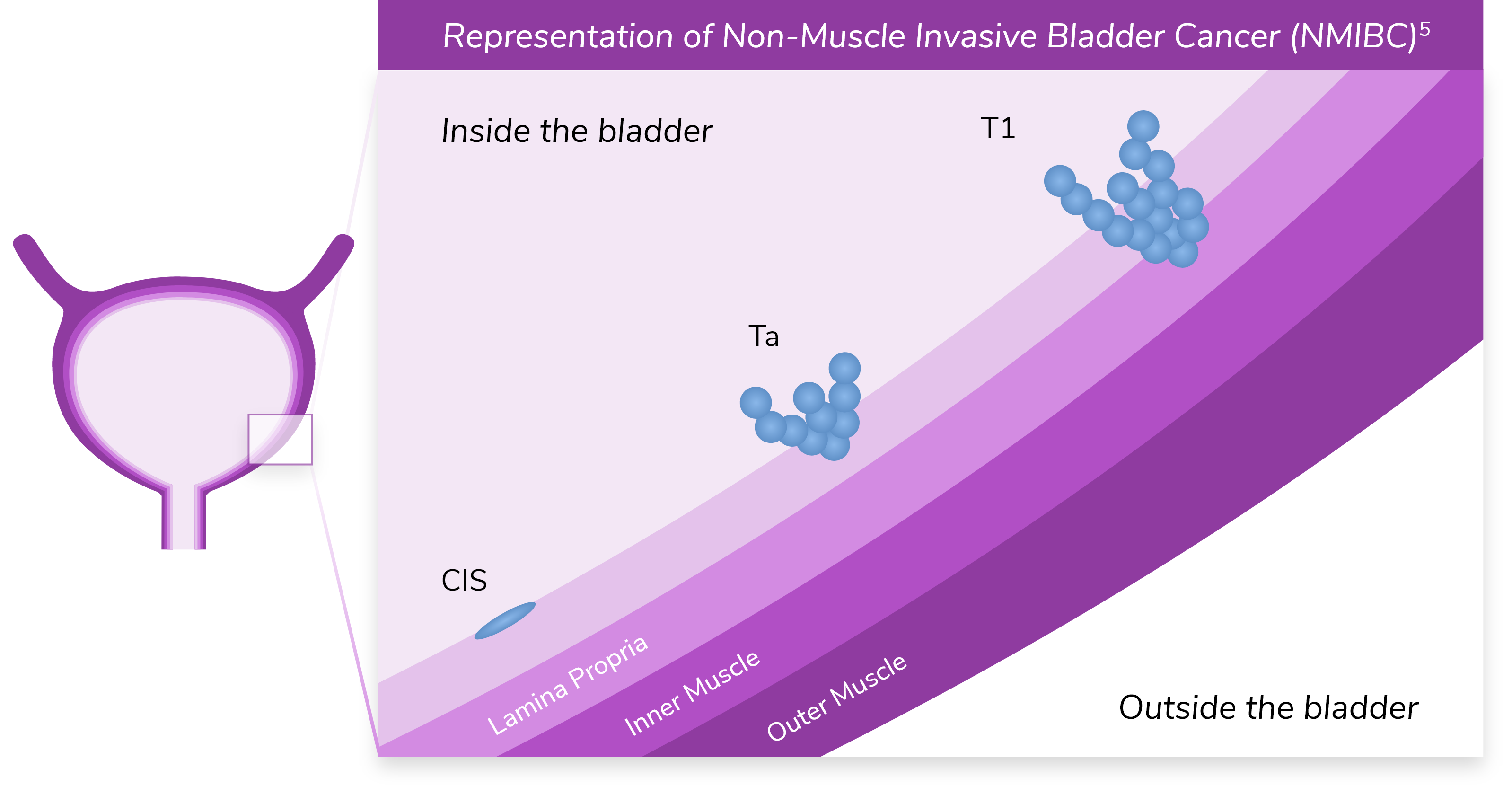
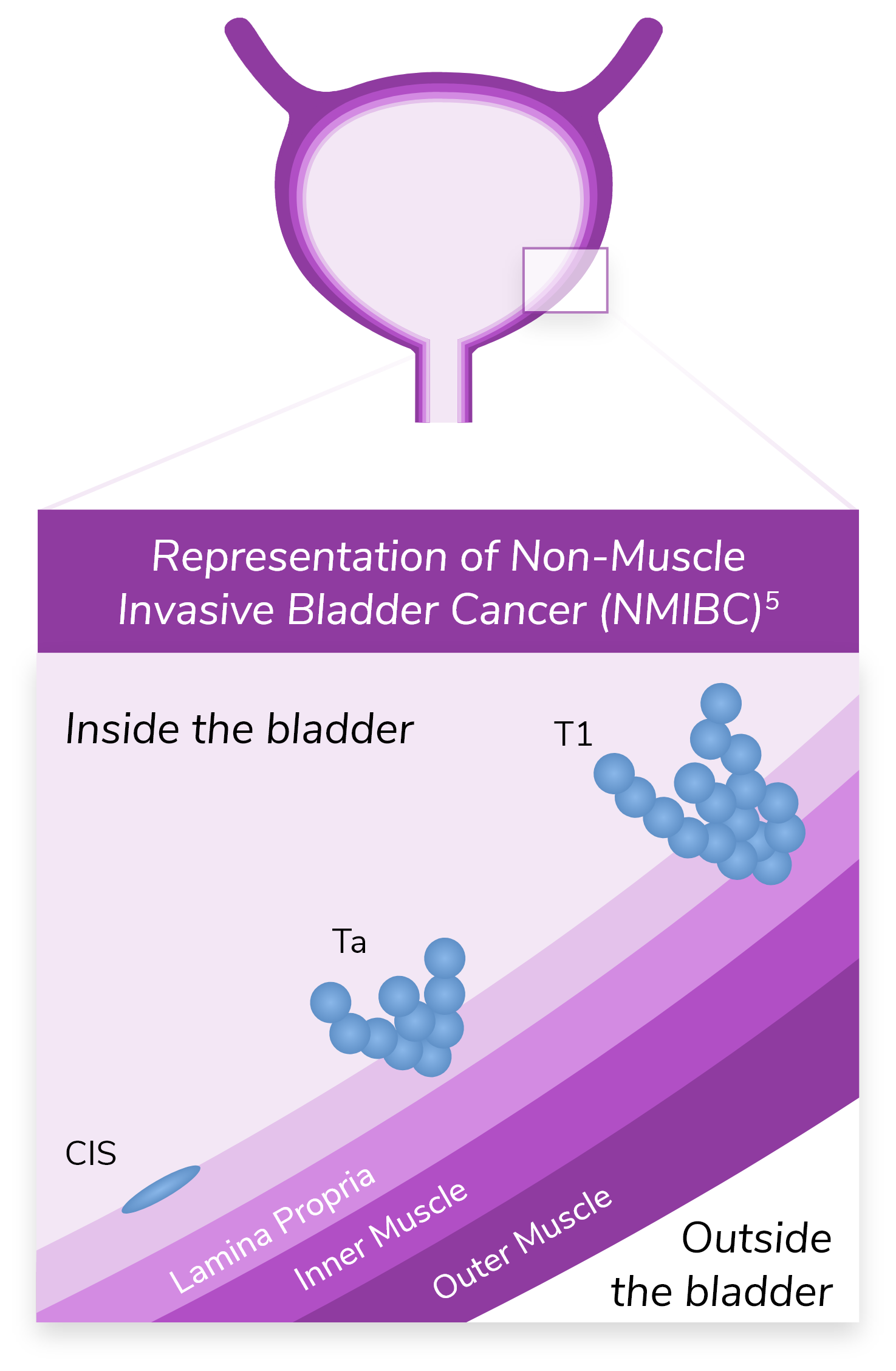
Inset image of a bladder, illustrating the stage at which bladder cancer patients are usually diagnosed Inset image of a bladder, illustrating the stage at which bladder cancer patients are usually diagnosed

The FDA defines BCG-unresponsive disease (BCG failure) as one of the following6:

Persistent or recurrent

Letters reflecting persistent or recurrent CIS plus or minus Ta/T1 disease within 12 months of adequate BCG therapy

disease within 12 months of adequate BCG therapy

Recurrent high-grade

Letters reflecting recurrent high-grade Ta/T1 disease within 6 months of adequate BCG therapy (include asterisk footnote)

disease within 6 months of adequate BCG therapy

Letters reflecting T1 high-grade disease following an induction BCG course

disease at the first evaluation following an induction BCG course

*Ta refers to noninvasive papillary carcinoma. T1 refers to a tumor that has invaded the lamina propria but has not penetrated the muscular wall of the bladder.5

Radical cystectomy (RC) carries a heavy burden

While RC is considered the gold standard for managing HR BCG-UR NMIBC, it is associated with7-9:

  • A high complication rate
  • Morbidity
  • Mortality
  • High long-term costs
  • Reduced body image and sexual function
Patients must weigh the risk of bladder cancer progression and a lost opportunity for a viable treatment option vs the risk of morbidity or lifelong impact on daily life

Bladder-sparing treatment options fall into various categories2:

Intravesical chemotherapy icon

Intravesical
chemotherapy

Systemic immunotherapy icon

Systemic
immunotherapy

Gene therapy icon

Gene therapy

IL-15 receptor agonist icon

IL-15
receptor agonist

An icon with 3 upward arrows that represents bladder cancer treatments in development

Treatments in
development

Shaping the future of bladder cancer treatment

With all the existing burdens of disease surveillance, and the burdens of current therapy on patients, it’s essential that the next step in a patient with bladder cancer’s life be one that considers the challenges they have faced—and will continue to face.

A refined therapy for NMIBC:
  • Is dual-acting and selectively targets bladder cancer cells10,11
  • Does not require combination with BCG12,13
  • Improves efficacy and durability of response13,17
  • Leverages familiar intravesical administration procedures and schedules that easily integrate into current urology practice18,19
  • Has a safety and tolerability profile that helps mitigate the barriers to improved potential outcomes13-16
Every bladder is precious. A focused commitment to novel and promising approaches aims to transform care for patients with NMIBC
References: 1. Holzbeierlein JM, Bixler BR, Buckley DI, et al. Diagnosis and treatment of non-muscle invasive bladder cancer: AUA/SUO guideline: 2024 amendment. J Urol. 2024;211:533-538. 2. Referenced with permission from the NCCN Clinical Practice Guidelines in Oncology (NCCN Guidelines®) for Bladder Cancer. V.3.2025. National Comprehensive Cancer Network, Inc. 2025. All rights reserved. Accessed January 15, 2026. To view the most recent and complete version of the guideline, go online to NCCN.org. 3. Rouanne M, Adam J, Radulescu C, et al. BCG therapy downregulates HLA-I on malignant cells to subvert antitumor immune responses in bladder cancer. J Clin Invest. 2022;132(12):e145666. 4. Lebacle C, Loriot Y, Irani J. BCG-unresponsive high-grade non-muscle invasive bladder cancer: what does the practicing urologist need to know? World J Urol. 2021;39:4037-4046. 5. Holzbeierlein J, Bixler BR, Buckley DI, et al. Diagnosis and treatment of non-muscle invasive bladder cancer: AUA/SUO guideline: 2024 amendment. J Urol. 2024. 6. U.S. Food & Drug Administration. BCG-unresponsive nonmuscle invasive bladder cancer: developing drug and biological products for treatment: guidance for industry. August 2024. Accessed January 15, 2026. https://www.fda.gov/media/101468/download 7. Maibom SL, Røder MA, Poulsen AM, et al. Morbidity and days alive and out of hospital within 90 days following radical cystectomy for bladder cancer. Eur Urol. 2021;28:1-8. 8. Berger I, Leilei X, Wirtalla C, et al. 30-day readmission after radical cystectomy: identifying targets for improvement using the phases of surgical care. Can Urol Assoc J. 2019;13(7):E190-201. 9. Catto JWF, Downing A, Mason S, et al. Quality of life after bladder cancer: a cross-sectional survey of patient-reported outcomes. Eur Urol. 2021;79:621-632. 10. Rahman MM, McFadden G. Oncolytic viruses: newest frontier for cancer immunotherapy. Cancers. 2021;13:5452. 11. Ramesh N, Ge Y, Ennist DL, et al. CG0070, a conditionally replicating granulocyte macrophage colony-stimulating factor—armed oncolytic adenovirus for the treatment of bladder cancer. Clin Cancer Res. 2006;12(1):305-313. 12. Ostrowski DA, Chelluri RR, Herzig M, et al. Diminished short-term efficacy of reduced-dose induction BCG in the treatment of non-muscle invasive bladder cancer. Cancers. 2023;15:3746. 13. Adstiladrin. Prescribing Information. Ferring Pharmaceuticals Inc.; August 2024. 14. Valstar. Prescribing Information. Endo USA; October 2019. 15. Keytruda. Prescribing Information. Merck & Co, Inc.; September 2024 16. Anktiva. Prescribing Information. Altor BioScience, LLC; April 2024. 17. Hannouneh ZA, Hijazi A, Alsaleem AA, et al. Novel immunotherapeutic options for BCG-unresponsive high-risk non-muscle-invasive bladder cancer. Cancer Med. 2023;12:21944-21968. 18. TICE BCG. Prescribing Information. Organon USA Inc.; February 2009. 19. Data on file. CG Therapeutics, Inc.
Contact
an MSL